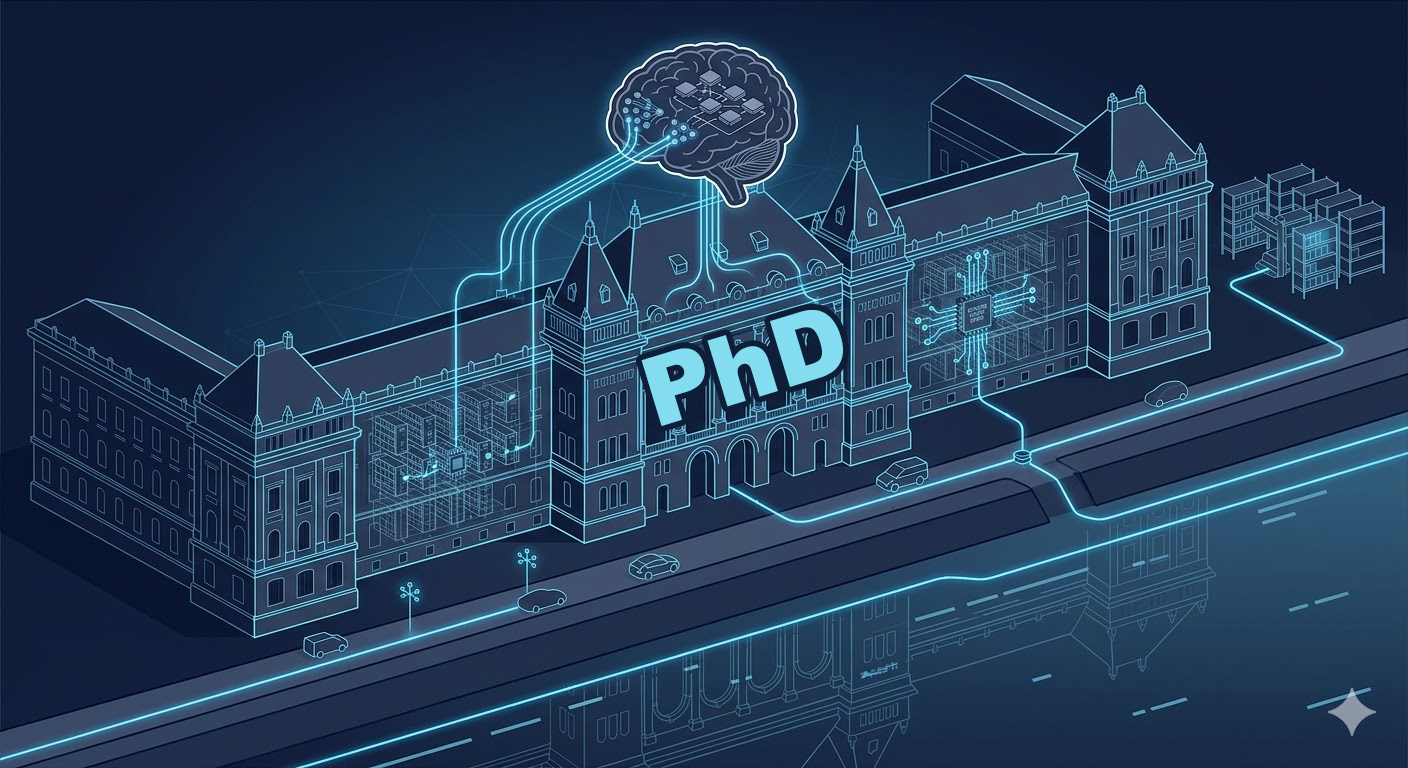
The educational and research-support role of the department in the PhD program can be divided into the following main areas:
1. Intelligent and autonomous vehicle control
- Intelligent and autonomous vehicle control systems: Within the framework of the course, high-level research is conducted on robust, LPV (Linear Parameter Varying) and MPC (Model Predictive Control) vehicle control design, predictive cruise control, as well as the interaction between autonomous and human-driven vehicles.
- Modern control theory and control engineering: The department teaches control design for achieving guaranteed and optimal performance (LQ, H-2, and H-infinity problems), as well as the stability of nonlinear systems, switched systems, and passivity-based controls.
2. Transport and network modeling
- Discrete event systems and their transport applications: Application of Petri nets, automata, and graph-type models for the modeling, dynamic analysis (e.g., reachability, deadlocks), and predictive diagnostics of transport systems.
- Road traffic modeling and control: Teaching macroscopic traffic models (e.g., LWR, Store-and-forward), highway and urban traffic control, and modern road measurement technology (Kalman filter, Moving Horizon Estimation).
3. Artificial intelligence and mathematical foundations
- Machine learning: Theoretical foundation of the curse of dimensionality, (hidden) Markov decision models, heuristics (dynamic and static), and the operation of artificial neural networks (supervised learning, self-learning systems).
- Mathematical methods: Parameter identification of dynamic systems, regression analysis, calculus of variations (Hamilton’s principle), and the theory of stochastic processes, which are essential for establishing research models.
4. Research methodology and publication skills development In addition to professional courses, the department plays a prominent role in preparing doctoral students for an academic career:
- In a separate course, they teach the management of publication databases, citation systems (e.g., Zotero), the use of the LaTeX text editor, the interpretation of novel publication performance metrics, and the theoretical basics of scientific article writing and dissertation preparation.
- The department’s instructors (as supervisors) coordinate the students’ teaching activities, independent research tasks, and the semester-by-semester progress of dissertation chapters (Preparation of Dissertation 1-3 and Teaching Activity 1-2 courses).
Overall, in the doctoral program, the department provides the high-level control theory, machine learning, and network modeling toolkit with which students are able to research even the most complex, forward-looking scientific problems of autonomous vehicles and modern transportation systems.