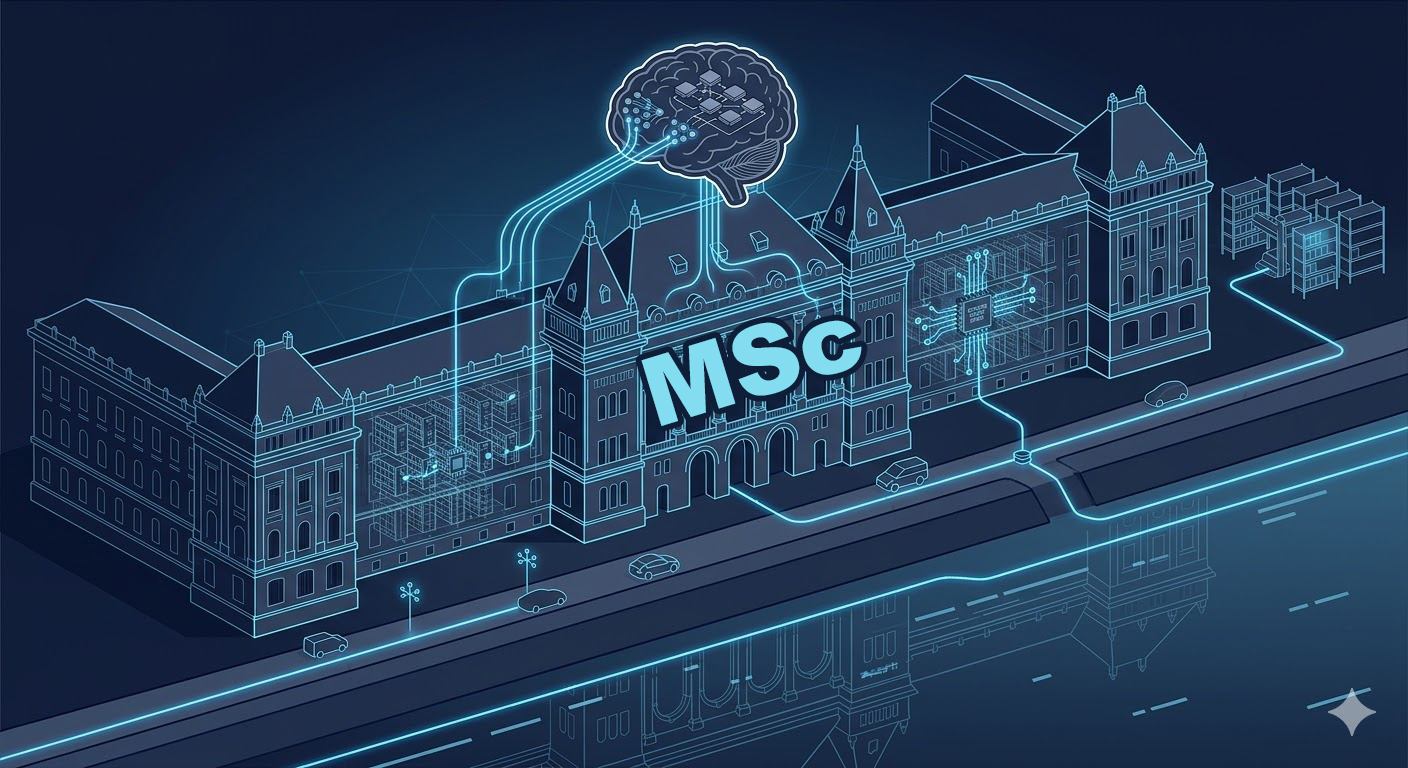
The main fields of study taught by the department, broken down by program:
1. Transportation Engineering MSc: In this program, the department focuses on network-level traffic control and the development of safety-critical systems:
- Safety-critical systems and automation: In the courses Transport Automation and Design of Transport Automation Systems, students learn about the development process of control and interlocking systems, the definition of safety requirements, and system integration.
- Control, information transmission, and signal processing: The course Vehicle-Track Information Connection presents the information transmission and traffic management procedures between the vehicle and the infrastructure. Signal Processing in Transportation teaches the embedded transport applications of microcontrollers and microprocessors, while the road specialization focuses on road traffic control systems and their modeling.
2. Vehicle Engineering MSc: For vehicle engineers, the main focus is the high-level design of mechatronic and electronic systems built into the vehicle:
- Electrical systems and measurement technology: The course Electrotechnics and Electronics deepens BSc-level knowledge by covering network analysis, the operation of active electronic devices (e.g., switched-mode networks, operational amplifiers), and complex vibration and noise testing measurement techniques.
- System-level design: The knowledge areas dealing with the modeling of mechatronic systems provide the foundation for functional architecture design, the V-model, and MATLAB/Simulink-based control design.
3. Autonomous Vehicle Control Engineering MSc (English-language autonomous vehicle control program): In this program, the department is responsible for teaching the most modern self-driving technologies:
- Environment perception and sensor fusion: The Automotive environment sensors course teaches the operation of radar, lidar, ultrasonic, and camera systems, as well as the fusion of sensor data (e.g., Kalman filter, SLAM, particle filter) for interpreting the vehicle’s environment.
- Reliability and safety (Safety & Reliability): The Safety and reliability in vehicle industry course discusses automotive safety standards (highlighting ISO 26262), hazard and risk analysis techniques (FMEA, FTA, HAZOP), and the development of safety-critical architectures.
- Numerical methods for vehicle control: The department also covers the error propagation, differential equation solving, and optimization algorithms required for computer modeling within the framework of Engineering mathematics.
- Independent laboratory and thesis design: The students’ software and hardware development, testing, and validation projects are also mentored by the department’s instructors.